
Metal 3D Printing in Engineering: Materials, Benefits, and Use Cases
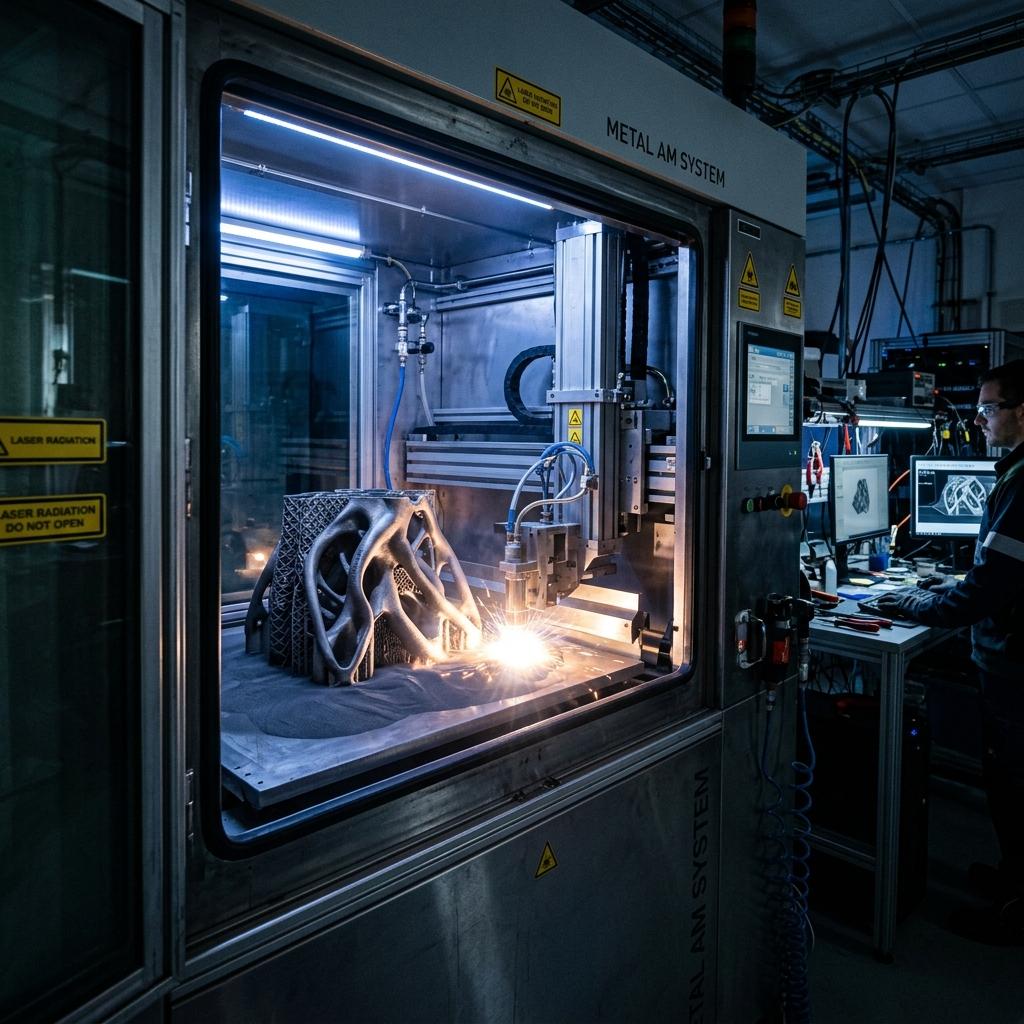
Metal 3D printing, specifically Direct Metal Laser Sintering (DMLS) and Selective Laser Melting (SLM), has revolutionized high-performance engineering. ThinkToReality's industrial metal additive services use high-power lasers to fuse fine metal powder layer-by-layer, creating strong, complex metal parts that are impossible to fabricate using traditional CNC milling or casting. This technology enables the production of custom aerospace brackets and complex heat exchangers.
Unlike polymer printing, metal printing involves extreme thermal gradients that require robust support structures to anchor components to the build plate. ThinkToReality's post-processing includes custom heat treatments to relieve stress and verify mechanical parameters.
Popular Engineering Metal Alloys
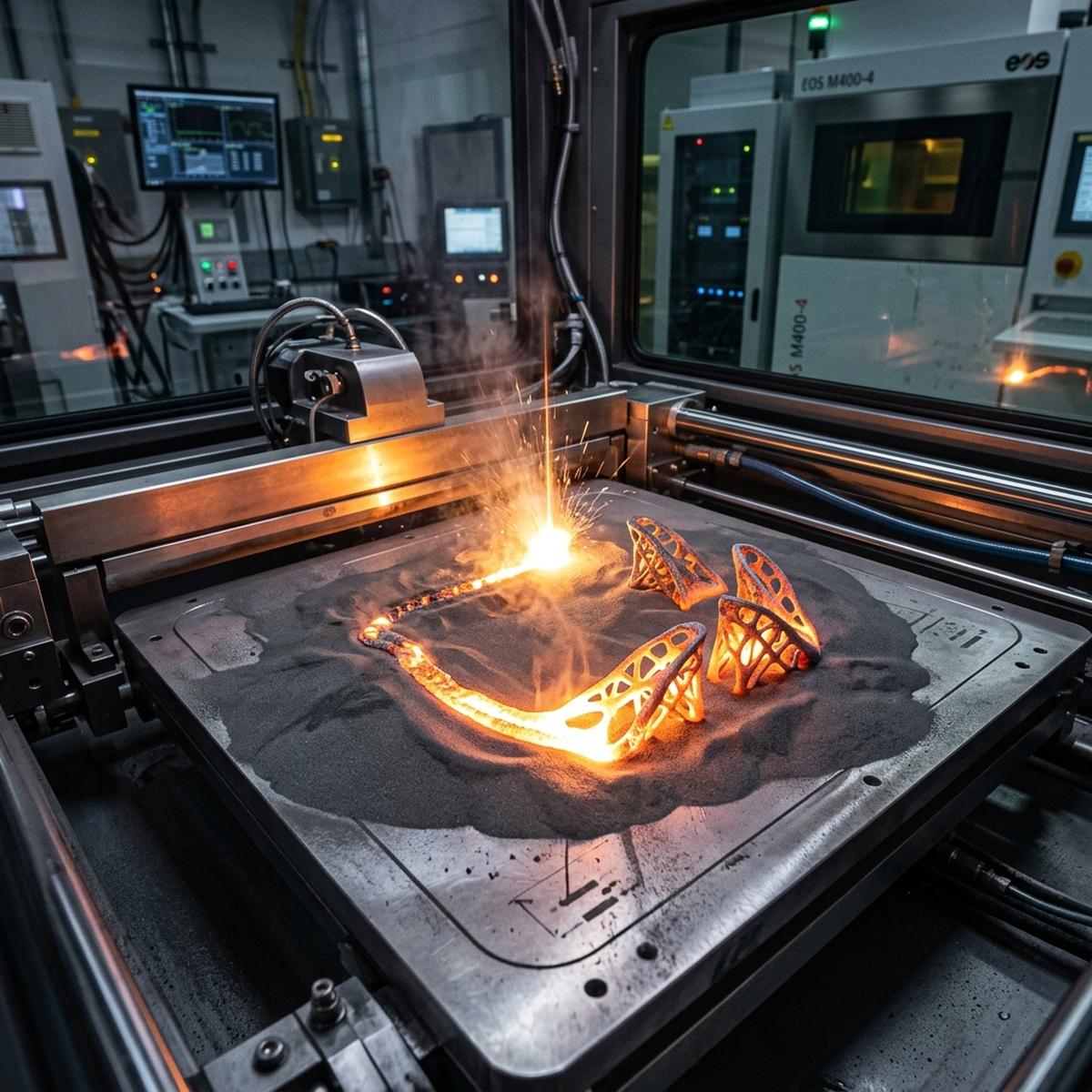
Direct Metal Laser Sintering (DMLS) active builds and finished titanium components at ThinkToReality.
* **Titanium (Ti64):** Exceptional strength-to-weight ratio, biocompatible, and highly corrosion-resistant. ThinkToReality prints Titanium for aerospace components and medical implants.
* **Stainless Steel (316L):** Durable, ductile, and chemically resistant. Excellent for food-grade parts, marine environments, and general mechanical components, fabricated by ThinkToReality.
* **Aluminum (AlSi10Mg):** Lightweight with good thermal conductivity and mechanical strength, making it ideal for automotive designs.
Unlocking Geometric Freedom and Topology Optimization
Traditional CNC machining requires clear tool access, limiting designs to simple lines and cuts. Metal 3D printing removes these constraints. ThinkToReality's software tools optimize part shapes, keeping material only where stress paths flow. This results in organic-looking, lightweight parts that maintain full structural strength while removing up to 50% of unnecessary weight.
Reducing Assembly Assemblies
Instead of welding or bolting ten different components together, ThinkToReality's metal 3D printing allows you to consolidate them into a single, unified part. This reduces weight, eliminates leak paths, simplifies quality checks, and speeds up product assembly.
Conclusion
While metal 3D printing has a higher initial print cost, the benefits of weight reduction, part consolidation, and rapid turnaround make it a highly valuable tool. ThinkToReality provides full-service metal 3D printing to elevate your engineering projects.
Related Insights
3D Printing for Healthcare in India: Costs, Benefits & Use Cases
Discover how 3D printing is revolutionizing healthcare in India, from custom implants and prosthetics to surgical simulations and anatomical models.
3D Printing in Architecture: Building the Future, One Layer at a Time
Learn how architects use 3D printing to create detailed models, construct complex shapes, and turn digital concepts into physical realities.